Showing posts with label Mildred's Lane. Show all posts

Tuesday, January 4, 2011

Carla

name: Carla

collection #: ML14

collection location: The Chicken Coop, Mildred’s Lane, Beach Lake, PA

age: mid thirties

occupation: artist

Relationship to food: strained

At the time that I interviewed Carla, her relationship to food was strained. Generally, it was in her disposition to take great pleasure in eating- pairing food with wine or going out to dinner and languishing in the length of time spent there. However, as she was in her second and final year of grad school, food had become more about survival than pleasure. She had lost her desire to cook and was functioning from the mindset of “what’s the quickest way I can keep my body moving”.

She grew into early adulthood with a very romantic notion of food. As an artist she enjoys process and always thought she’d have a particular relationship with food preparation, one where she spends hours in the kitchen doing something such as making pasta from scratch. I suffer from this same notion. I revel in the idea of mixing the perfect dough, rolling it out over and over in the pasta maker. Carla has, however, never really done this and as she gets older, she is growing comfortable with the idea that she just may not be one of those people who makes pasta from scratch. She credits this with the fact that she eats alone. She believes it has killed her desire for the process of food preparation as it lacks a community and ritualistic atmosphere.

Her greatest food memory is of coffee. Her parents brought the ritual with them from Columbia. They have a pot together as a family to start the day. They always have a pot of coffee with dinner and they finish their day with it too. When she moved to NY several years ago, she lived alone for the first time. On her first day in her new apartment, she bought a coffee pot and a bread machine, both equipped with a timer. She set them to go off the next morning at the same time and still remembers the amazing scent of both as they baked and brewed. To her it felt like the ultimate in spoiling herself. She still feels the same way when she rewards herself with a really good cup of coffee.


But my favorite of food memory of Carla’s is one told of green olives (the kind stuffed with pimentos) and her sister. When she was young, Carla wanted to be just like her sister: wearing clothes like her, changing clothes when she changed clothes, ordering the same things when they went out…and this drove her sister crazy. One day at a salad buffet, her sister dared her to eat 100 olives in a row. She remembers being really little and fighting through it but eating them all. The thing she finds funny about this story is that she still loves olives. She finds it amazing every time she eats olives that she still loves them because when she does she always thinks of her sister and that moment. It makes her question the food that we love and the foods we hate and why we love or hate them, because that was one of those moments that could have changed her relationship with green olives forever. But it didn’t. Not in the slightest.

Wednesday, December 22, 2010

Jaquel


name: Jaquel

collection #: ML10

collection location: The Chicken Coop, Mildred’s Lane, Beach Lake, PA

age: undisclosed

occupation: personal organizer

Relationship to food: afraid


Jaquel’s relationship to food is challenging. She is afraid of food. She explains to me that she ate poorly from childhood through early adulthood and as a consequence, has had a history of digestive trouble. As an adult she has found that her body works best when she doesn’t eat too much. So she eats a little at a time, otherwise she can’t digest it. (I should interject here that this does not make Jaquel a waif. She is hearty, vivacious, has beautiful red hair and is fit. She listens to her body enough to know its limitations and makes adjustments accordingly.) However, because of her relationship, she is afraid to dabble in new foods on her own. She seems to know what makes her healthy now and is afraid to push her body’s limits.

When I asked her about her food memories, she interestingly enough, had immediate memories of food from her childhood. She chose not to speak about the countess bags of chips and fast food she ate and instead specifically remembered eating walnuts at her grandmother’s and the process of cracking them open. Her grandmother worked at a camp and would bring home the spoils of the summer at the end of the season. She loved the colored candy on strips of white paper, candy buttons I believe they are called.

I did a little research on candy buttons, to find out their specific

name (which I mistakenly was calling dots) and found a page that shows you how to make them yourself. Sure, they don’t really taste like much, but that was never really the fascination about them in the first place, was it. What I loved about them myself as a child was the fact that they were on a big role in the store and you bought it by the row, tearing off as much or as little as you wanted. You could get a strip as tall as you, as it was inexpensive, and it would take days to eat that much candy off the paper. It was not cellophane wrapped as it is now and was immediate satisfaction. But I digress…

Jaquel also thought that broccoli looked like green trees as a child. She remembers eating the “heads” off the “trees” and getting in trouble for what her mother considered playing with her food. I think we should capitalize on this idea more…

At the end of her interview, after relieving these food memories from her childhood, Jaquel remarked to me that if she could start collecting food memories as an adult, she would like to remember what is was like when she started eating good food.


walnut image can be found at nature products.net
candy button image and blog entry about nostalgic candy can be found here

Wednesday, December 1, 2010

Days Past

Before I start sifting through the stories from the Physical Center Collection, I should pay homage to the event that started this project. In the summer of 2009, I was asked to be a guest chef for the Mildred’s Lane Social Saturday Lecture Series. Mildred’s Lane is a bucolic space that is a perfect retreat from the rest of the world. It is part residency, part educational workshop, part on-going art event, part think tank and part experiment in collective/alternative methods of living. The Social Saturday Lecture series is a way to interact with both the local community and connect with the larger art community through discourse and food.


Social Saturday Dinners are major events involving hours of aesthetic preparation of the meal. From the table setting to the food presentation to the dishwashing stations.

Even the refrigerator gets a makeover.


The whole meal is an aesthetic experience.

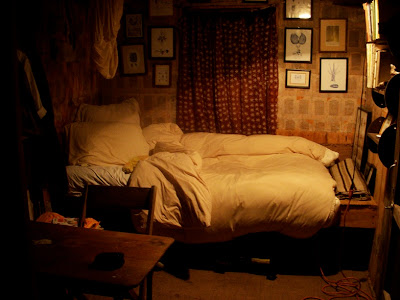
I was also a resident artist at Mildred’s Lane for the last project session and was looking for a way to combine my interest in memory culture* with the food projects I had been conducting for the two years prior. As a result, I decided to conduct a series of interviews with the current fellows and residents about their relationship to food and their memories associated with food. Interviews were primarily conducted in my living space, the Grafter’s Shack.


What was once a project installation is now a small sleeping accommodation. The space is quiet and removed, an excellent place to have an intimate interview and travel back in time. The interview was conducted much in the same way that it is now. A small amount of personal information was collected [like name, sex, age, occupation] and I asked a few questions about their relationship to food. [During this time, I want people to feel comfortable and believe that the type of memories people have and the experience people have reliving them can be dictated by a positive, negative or neutral relationship to food. To this end I have added tea and cookies to the interview process. This seems to give participants a sense of comfort, even if their relationship to food isn’t the most positive.] Time was left at the end for talking about their food memories.

The memories and ingredients were then sorted and gleaned to create the recipes for the meal I was in charge of as a guest chef. I wanted to create a collective meal, the creation of which was dictated by the memories of the people who were there during the week. This was the start of my interest in looking at the way food is created and consumed, physically, visually and metaphorically.


This event and the collection of memories is just as much a part of the Physical Space Collection and in this forum, I will be discussing the food memories collected at both of these spaces as well as collections yet to come.


*memory culture is predominantly the visual study of memorials, architecture and public grief, but also draws on oral story telling, photography, politics and cultural studies just to name a few.